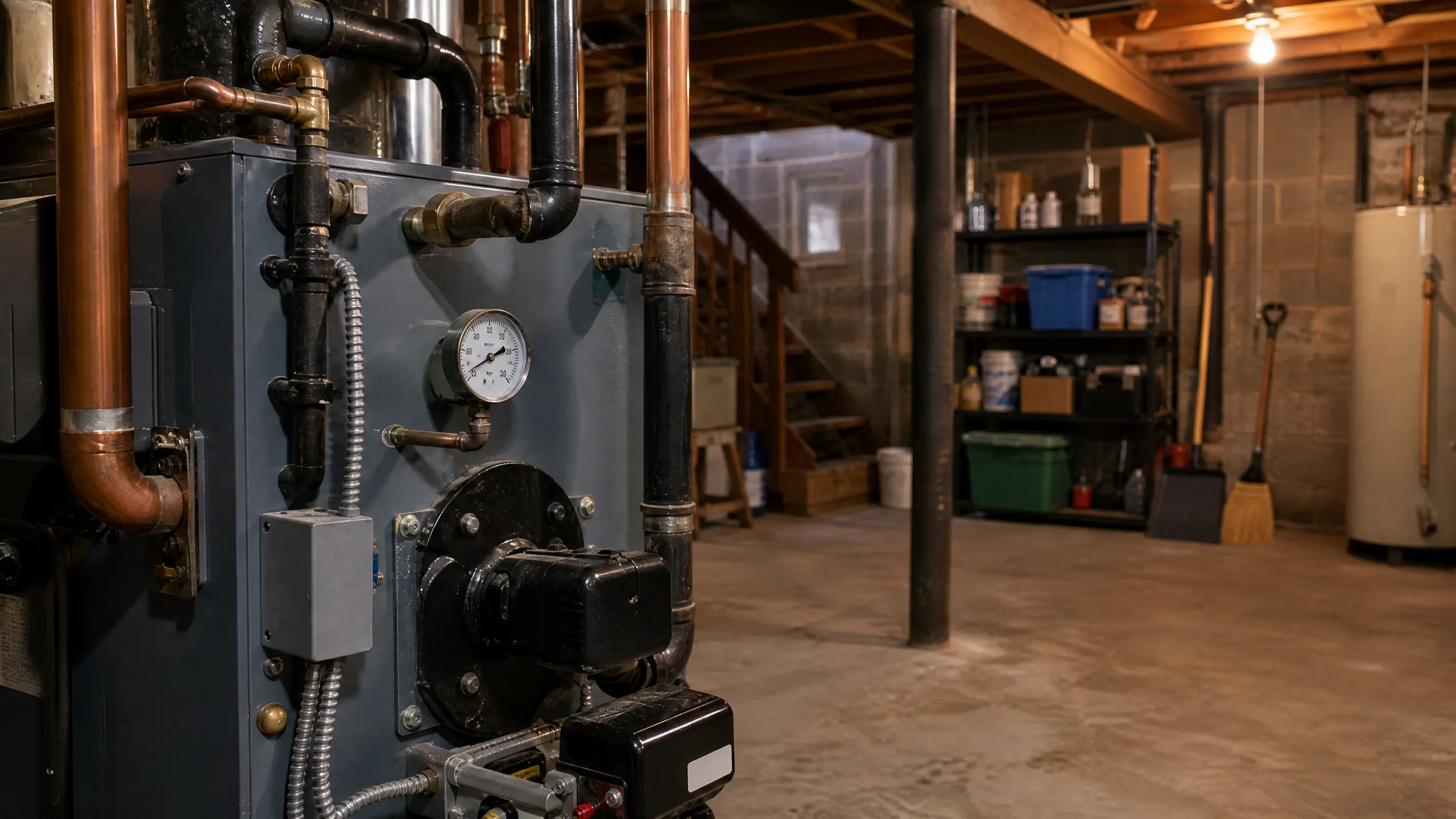




A basement mechanical room with a gray boiler connected to copper and iron pipes, a pressure gauge, and a water heater visible in the background.

Boiler Repair in Boston, MA

Tell us about the job

Takes about a minute. No obligation.

RepairBoilerSuffolk County, MA
Step 1 of 2

What ZIP code is the job in?

Boilers in Boston run from October through May, about eight months of the year. September is worth a check before that starts. A lot of repair calls come in those first cold weeks, when the boiler finally has to work hard after sitting idle, and whatever was already weak gives out. A pilot that wouldn't quite stay lit in September turns into no heat at all in October. Getting it looked at before the season starts means catching that kind of problem on your schedule, not on the first cold night.

A kettling boiler is telling you the heat exchanger has scale or sludge built up on it.

Keep running it hot and that spot can crack, which turns a cleaning job into a heat exchanger replacement.

Boston runs its boilers hard, and gas here costs more to waste

Heat runs October through May
Winter nights average 23°F
22 winter storms from 2015 to 2024
Eight months of heatBoston homes run their boilers October through May, with overnight lows averaging 23°F in January.

A boiler that short cycles or kettles isn't just annoying, it's burning gas it doesn't need to. Massachusetts gas ran $21.27 per million Btu in 2024, among the higher rates in the country, and a boiler working around a bad problem uses more of it to put out the same heat. That cost shows up on every bill until the actual cause gets fixed, not just the symptom. A technician can find out in one visit whether this is a quick fix or something building toward a bigger repair. Waiting doesn't make the gas cheaper or the problem smaller.

If this boiler is original to an older home, repair may not be the real question

Half the homes in Suffolk County were built in 1949 or earlier. A boiler that came with a house that old has likely been replaced at least once, maybe more, and the one in there now could be on its way out too. Before paying for a major repair, it's worth asking a technician how much life is left in it.

Find a contractor

Check the pressure gauge first

A boiler runs on water pressure, and the gauge usually marks where it should sit. If the needle has dropped low, the system may be losing water somewhere, or it just needs a top-up through the filling loop. If it's climbing too high, don't keep adding water. Either way, writing down what the gauge reads before anyone comes out gives the technician a head start.
Look at the pilot or ignition window

Most boilers have a small window or sight glass where you can see the flame. A steady blue flame is normal. A flame that's yellow, orange, or keeps going out points to a combustion problem, and that's not something to keep relighting over and over. If the pilot won't stay lit at all, that's worth telling the technician before they arrive, since it changes what they bring to the first visit.

Some boiler problems are worth fixing no matter the age of the unit. A failed thermocouple, a bad zone valve, a circulator pump that's seized, these are specific parts that can be replaced on their own, and doing so brings the whole system back to normal. A cracked heat exchanger is different. That's the part that actually holds the water being heated, and it isn't sold as a separate piece from the boiler itself. When that cracks, the repair and the replacement are the same job. The other thing worth asking about is the control board or anything tied to parts that are no longer made for an older model. A tech having to hunt for an obsolete part, or rig around one, is a sign worth paying attention to on its own.

A diagnostic visit starts before any panel comes off. The technician asks what the boiler is doing, when it started, and whether it happens at a specific point, like startup or when hot water is called for. Then comes the pressure gauge, a look at the flame, and a listen to how the burner sounds lighting off. From there it's a process of ruling things out. Is a zone valve stuck. Is the thermocouple or ignition sensor reading right. Is the pump actually moving water through the system. Each test either clears a part or points to it. By the end, the problem usually has a name, a part, and a straight answer on whether it's a same-visit fix or something that needs a part ordered in.