Oil heats more homes here than anything else
Fuel oil or kerosene heats 37.9% of occupied homes in Worcester County, more than gas or electric. Gas runs second at 32.4%.
Takes about a minute. No obligation.
Fuel oil or kerosene heats 37.9% of occupied homes in Worcester County, more than gas or electric. Gas runs second at 32.4%.
Most homes here keep their oil or gas furnace for the coldest months and add a mini split for the rooms that need their own control, or for cooling in summer. The install has to work alongside what's already heating the house, not replace it.
NOAA nClimDiv, 1991–2020 normals
Cooling in Worcester County runs July through August.
Get a mini split installed before July and it's ready on the first hot day, not after your house has already been sitting in it.



Electricity in Massachusetts ran 29.35 cents per kilowatt-hour in 2024, so what a mini split costs to run comes straight out of that rate. That's a reason to get the sizing right, not a reason to go bigger. A unit sized to the room it's heating or cooling, at a standard efficiency rating, covers the job without wasting what you're paying per kilowatt-hour. Oversizing a mini split doesn't mean more comfort, it just cycles on and off faster and wears sooner. The contractor sizes it to the room once they've seen it, and a standard unit is what most rooms call for here.
Worcester County sits in climate zone 5A, a cold-winter zone under the 2021 energy code. Any mini split installed here, no matter the brand, has to meet 14.3 SEER2 for cooling and 7.5 HSPF2 for heating, the same minimum as any other split-system heat pump. That's the floor a new install has to clear before it goes in.
Find a contractorTwo months of cooling a year, July and August, with afternoon highs averaging 79. That's a light summer load. The heating side runs far longer, which is why most homes here keep their oil or gas furnace and let the mini split handle the rooms that need their own control. A standard unit sized to the room covers both jobs fine. There's nothing about the cooling load here that calls for a bigger compressor or a higher-tier model.
Every outdoor compressor has a limit on how many indoor heads it can run well at the same time. Add more zones to the same compressor and it has to split its capacity across all of them when they call for heat or cooling together. Ask what the system does when every zone is running on the coldest day, not just a mild one.
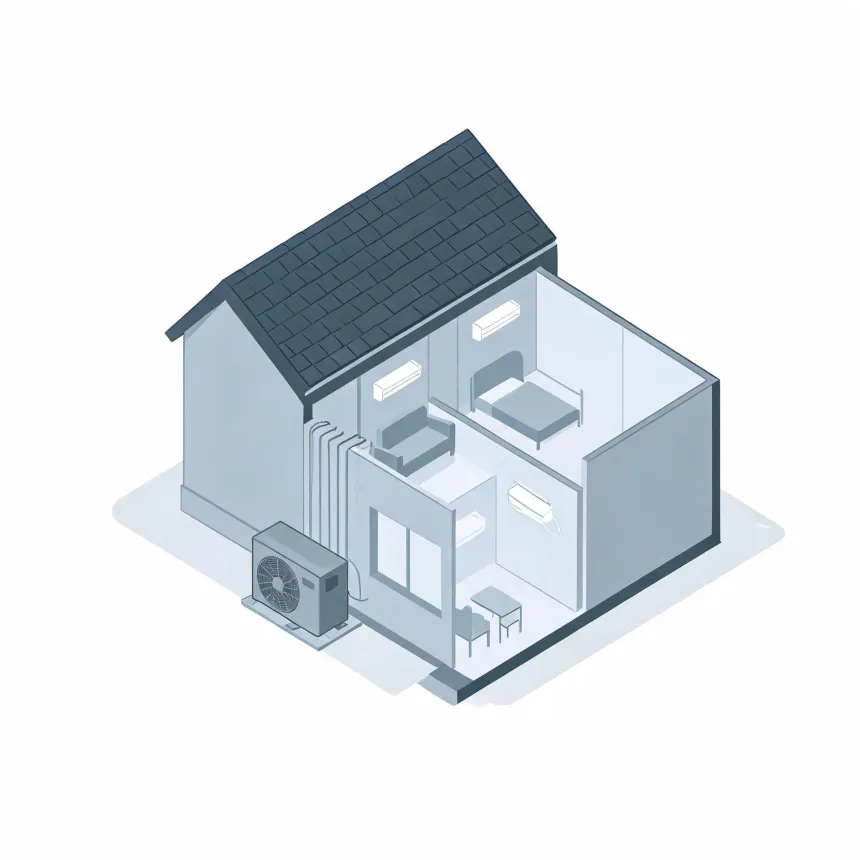
The indoor head connects to the outdoor unit through a line set carrying refrigerant, and that line has to get from one to the other through a wall, a chase, or along the outside of the house. Where it runs affects how the install looks when it's done and how hard the unit is to service later. A contractor who hasn't worked out the line set path yet hasn't finished sizing the job.
What drives the cost of a mini split install is mostly what has to happen before the unit goes on the wall. Running the line set is the biggest piece of it. A short, straight run between the outdoor compressor and the indoor head takes less time and less material than one that has to go up through a floor, around framing, or along the outside of the house and get covered after.每 added zone means another indoor head, another line set run, and another spot where the wall gets opened up, so a multi-zone job costs more than a single head almost entirely for that reason. Electrical work adds to it too, since a mini split needs its own dedicated circuit and breaker, and if the panel doesn't have room for one, that's its own job before the install starts. Where the outdoor unit sits matters as well. A spot that's easy to reach and close to the electrical panel costs less to wire and service than one tucked against a far wall or up on a roof bracket.
Install day starts with the outdoor compressor going onto its mounting pad or wall bracket, then the line set gets run between that and the indoor head. That run has to be drilled through the wall, so there's a hole being made in your house before anything else happens. The indoor head goes up next, mounted high on the wall where it can pull air across the whole room. Once both ends are set, the line set gets connected, the system is evacuated to pull out any air and moisture, then it's charged with refrigerant and checked for leaks at every joint. The electrical hookup to its dedicated circuit happens alongside that. Last comes the test run, heating and cooling both, to make sure the head is actually conditioning the room and not just blowing air.