Electricity here runs 29.35 cents a kilowatt-hour
Massachusetts electric rates are among the highest in the country. A mini split draws power every hour it runs, so that rate applies to every cycle, all year.
Takes about a minute. No obligation.
Massachusetts electric rates are among the highest in the country. A mini split draws power every hour it runs, so that rate applies to every cycle, all year.
On a per-watt basis, a mini split that uses less power to do the same job will cost less to run than one that doesn't. At Massachusetts rates, that difference carries more weight than it would somewhere with cheaper power.
NOAA nClimDiv, 1991–2020 normals
Cooling runs July through August here, just two months, but they're the two months that matter.
June is the month to get a mini split installed, before the first hot stretch asks something of it.




Dukes County is in climate zone 5A, a cool zone where heating carries more of the year's work than cooling does. A ductless mini-split heat pump counts as a split system under the federal standard, so the same minimums apply as they would to a central system. A unit manufactured from 2023 on has to hit at least 14.3 SEER2 for cooling and 7.5 HSPF2 for heating. That's the floor, not a target, so any system installed here will meet it or better it. A federal tax credit is available on top of that for equipment that qualifies, separate from anything a utility offers.
At 29.35 cents a kilowatt-hour, the difference between an efficient mini split and a middling one shows up on every bill, not just the summer ones. Get the sizing and the install right from the start and that rate works for you instead of against you.
Find a contractorIf what's coming out is an old mini split, the outdoor unit and indoor head both come off the wall, and the line set between them usually comes out too rather than getting reused. If what's coming out is a furnace or a boiler with ductwork, that ductwork can often stay in place even once the mini split is doing the heating and cooling. Refrigerant in the old outdoor unit has to be recovered into a tank, not released into the air. That part is not optional. Any patched line set holes or old mounting brackets get sealed or pulled so the wall is clean for what's going in next. None of this is a quick swap, and the old equipment leaving is as much a part of the job as the new equipment arriving.
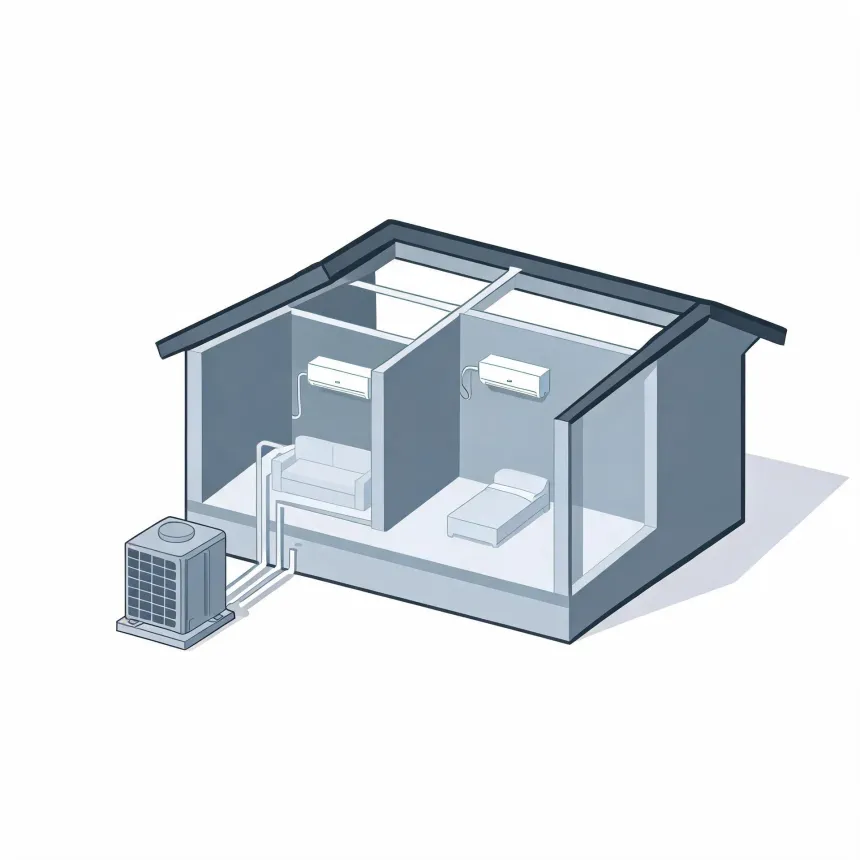
A single indoor head only heats and cools the room it's mounted in. If the system needs to cover more than one room, ask whether that means multiple heads on one outdoor unit or a separate system for each area. More heads on one outdoor unit costs less to install but if that unit fails, every zone tied to it goes down at once.
Every mini split has a capacity rating at low temperatures, and that number drops as the outdoor air gets colder. Ask what each system is rated to put out at the coldest point your area sees, not just its rating at mild temperatures. A system that looks identical to another on paper can fall off a cliff in output once it gets cold enough, and that's the difference between a mini split that carries the heating load and one that needs backup.
Sizing a mini split is not about matching the room's square footage to a number on a brochure. The contractor works out how much heat the room loses on the coldest day and how much it gains on the hottest, based on the windows, the walls, the ceiling height, and how they're laid out. A unit sized too big cools the room fast and shuts off before it pulls the moisture out of the air, so the room feels cold and damp instead of comfortable. One sized too small runs flat out all day and still can't keep up when the temperature swings hard. Oversizing also means more wear on the compressor, since it's cycling on and off hard rather than running steady. The right size is the one matched to the room through that load calculation, not the one that seems safest to round up to.
What drives the cost of a mini split install is mostly what it takes to get refrigerant lines, power and a mounting point to exactly where the indoor head and outdoor unit need to sit. A straight shot through one exterior wall, with the outdoor unit set close by on an existing pad, is the simplest version of this job. Add distance between the indoor and outdoor units and the line set gets longer. That means more refrigerant, more time running it, and more places it has to pass through framing or finished walls. More zones means more indoor heads, more line sets, and sometimes a larger outdoor unit to carry them all, so the cost scales with how many rooms are getting their own head rather than staying a flat number. Electrical work adds to it too. A mini split needs its own dedicated circuit, and if the panel doesn't have room for one, that's a separate job before the mini split itself goes in. None of this is about the brand on the unit. It's about how far the lines have to run and how much has to change to get them there.