Electricity here runs 29.35 cents per kilowatthour
Massachusetts power costs more than most of the country. A mini split that loses efficiency through a bad install or an undersized unit will show that cost on every bill that follows.

Takes about a minute. No obligation.
Massachusetts power costs more than most of the country. A mini split that loses efficiency through a bad install or an undersized unit will show that cost on every bill that follows.
A mini split sized to the room, mounted correctly, and charged to the right level moves heat or cooling using less electricity. At this rate per kilowatthour, that difference is worth checking into before you pick the system.
NOAA nClimDiv, 1991–2020 normals
Fuel oil, gas or propane heats most homes in Hampden County, and a mini split is usually added alongside that system rather than replacing it.
Sized right, it can cover the mild months on its own and take some of the load off a furnace or boiler the rest of the year.




Hampden County sits in climate zone 5A, a cool zone where heating is the bigger job over the year. Any ductless mini-split sold here still has to clear the same federal minimum as other split-system heat pumps built from 2023 on. That means 14.3 SEER2 for cooling and 7.5 HSPF2 for heating. There is no lower bar for ductless systems. A unit priced below the others on a quote still has to meet that same number to be sold at all. A federal tax credit is available for qualifying heat pump installations, and it is worth asking a contractor about when comparing systems.
Cooling here only runs two months a year, with afternoons near 80. A standard mini split, sized right for the room, handles that load without trouble. There's nothing about the heat or the climate here that calls for going bigger or stepping up to a pricier unit.
Find a contractor
This machine doesn't run alone in an older home. The room it's mounted in holds heat or loses it differently than a room built to a newer code, and that changes what the indoor unit has to do hour to hour. A contractor sizing the system should walk the room itself rather than go by square footage alone, and check what's already heating the house before settling on a unit.
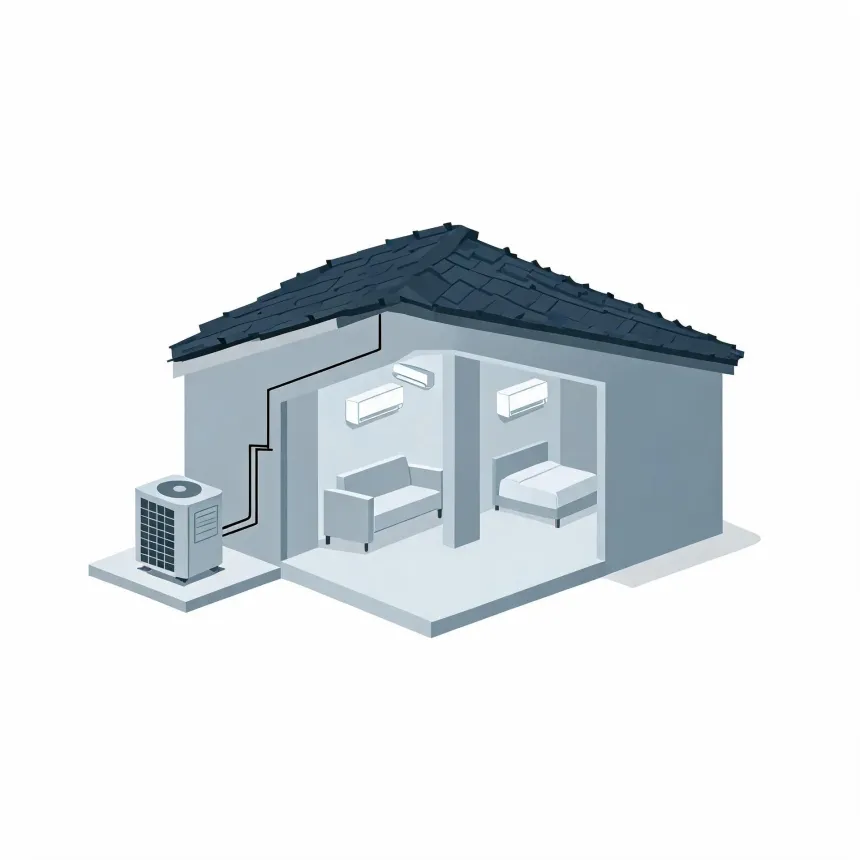
One indoor head and one outdoor unit costs less than a system covering several rooms off the same compressor. Each added zone means another line set run through the wall, another mounting job, and another indoor unit to hang level and secure. The outdoor unit also has to be sized to carry every zone running at once, not just one.
The refrigerant lines running between the indoor head and the outdoor unit have to be brazed, pressure tested, and run through a wall or along an exterior path. A straight shot through to an outdoor unit sitting right outside costs less labor than a line set that has to travel through a floor, around framing, or up several stories to reach a spot the outdoor unit can actually sit.
A few questions sort the real comparison from the brochure. Ask what SEER2 and HSPF2 the exact model carries, not just the product line, since ratings shift between versions of the same unit. Ask whether the quote covers a single zone or is sized to add more later, because a compressor picked for one room now can't just take on a second line set down the road. Ask what refrigerant the system uses, since that affects what service and parts look like years from now. Ask how the contractor is sizing the unit, whether by a room-by-room load calculation or just square footage, because that number decides whether the system is a fit or a mismatch from day one. And ask what the warranty covers if it's not installed by someone certified on that brand, since some manufacturers tie coverage to that.
A mini split that's too big for the room cycles on, cools or heats the air fast, and shuts off again before it pulls the moisture out or settles the temperature evenly. That's what short cycling is, and it wears the compressor harder over the long run too, since starting up draws more than running steady does. Too small and it runs constantly, straining to keep up on the hottest or coldest days without ever getting there. The right size comes from a load calculation, not a guess based on square footage. That calculation weighs the room's exposure, its windows, its insulation and what's already heating or cooling it, then matches the indoor head and outdoor unit to what the room actually needs to move. Get that number wrong and no install quality fixes it afterward.