A row of white Colonial-style houses with glowing windows photographed at dusk along a road bordered by a stone wall.

Mini Split Installation in Quincy, MA

Tell us about the job

Takes about a minute. No obligation.

New system or replacementMini-splitNorfolk County, MA
Step 1 of 2

What ZIP code is the job in?

Electricity here runs 29.35 cents per kilowatthour

Massachusetts electricity cost 29.35 cents per kilowatthour in 2024, well above what most states pay. A mini split that runs efficiently matters more here than somewhere power is cheap, because every kilowatthour it uses or saves shows up bigger on the bill.

The SEER2 rating is the number to compare

When you're comparing mini splits for a Quincy home, look at the SEER2 rating on each unit. It tells you how much cooling or heating you get for the electricity it draws. Two systems that cost the same to install can run very differently once the power bill arrives.

8 months
October through May, your system heats
2 months
July through August, it cools
21°F
the average winter night it heats against
81°F
the average summer afternoon it cools against
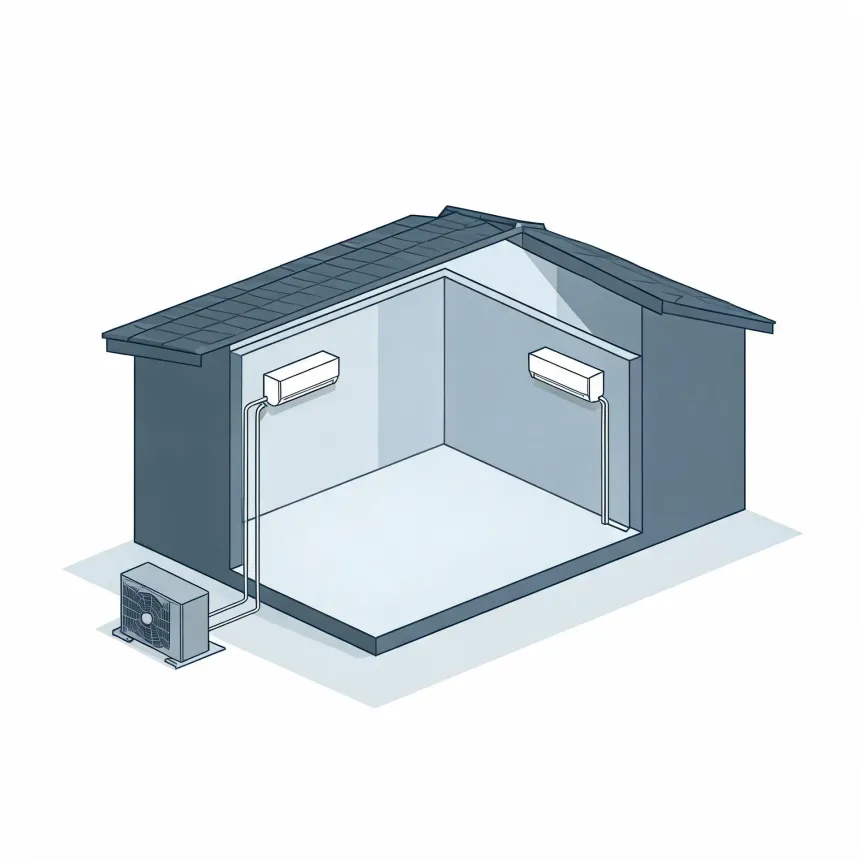
Cutaway isometric illustration of a small building interior showing two wall-mounted indoor air conditioning units connected by line sets running down to a single outdoor condenser unit on the ground outside.
Your system heats October through May and cools July through August.

NOAA nClimDiv, 1991–2020 normals

Quincy gets two months of real cooling, July and August.

A standard size mini split handles summer heat here without trouble.

Cooling starts in July. Get it installed before then, not after.

Cooling runs July through August
Summer afternoons average 81°F
462 damaging wind events from 2015 to 2024

Norfolk County sees its share of rough weather, including 462 damaging wind events over the past decade. None of that changes what a mini split needs to be. A standard size, correctly matched to the space, holds up fine through a winter storm or a summer squall here. What the weather does affect is the power behind it. A mini split is only as reliable as the grid it runs on, and outages do happen in Massachusetts. That's not a reason to size up the unit. It's a reason to ask your contractor whether a backup power option makes sense for your home.

Half the homes here were built in 1964 or earlier. The mini split has to fit that house

Half the homes in Norfolk County were built in 1964 or earlier. A mini split going into a house that age is going into a layout the manufacturer never saw. Sizing and placement have to answer to the house you have, not a standard floor plan.

Find a contractor
A man in a cap, gray long-sleeve shirt and brown work pants walks up porch steps toward a dark blue front door, carrying a canvas tool bag with tools in its side pockets, beside a potted shrub.
A white outdoor air conditioner condenser unit mounted on metal wall brackets against gray horizontal siding, with a blue sky and white clouds behind it.

Size it to the house, not the square footage

Ask the contractor to do a room by room load calculation rather than sizing off square footage alone. In a newer house that shortcut usually comes close enough. In a house built in 1964 or earlier, the walls, the windows and the room layout can throw that number off, and the result is a unit that short cycles or one that never quite keeps up. The calculation also tells you where the lines can run and where the outdoor unit can sit, which matters just as much in a house that wasn't built with this equipment in mind.

The line set comes first

The crew runs the line set between the outdoor unit and each indoor head before anything else happens, because that path decides where the hole through the wall goes and how the indoor head gets mounted. The hole is small, just wide enough for the refrigerant lines, the power wire and the drain line to pass through together. Everything after that follows from where this hole ends up.

The indoor head goes up before it's wired live

The indoor head mounts to a bracket on the wall first, with the lines connected but the system not yet running. The outdoor unit gets set on its pad or bracket, the lines get connected at that end, and the whole system gets checked for leaks before the refrigerant is released to flow and the power gets turned on.

SEER2 is tested under a standard that pushes more resistance through the system than the old rating did, so it runs a little lower than the number you might remember from an older unit, even on equipment that performs the same or better. The rating tells you how much heat the unit moves per unit of electricity it draws. It says nothing about whether that unit belongs in the room it's going into. A mini split with a strong rating still wastes power if it's too big for the space, because it shuts off before it finishes pulling the moisture out of the air and starts right back up again. That start and stop costs more than the rating on the label would suggest. Compare the rating between units you're actually considering, but let the room decide the size.

The equipment itself is only one line on the bill. Where the lines run, how far the outdoor unit sits from the indoor head, and what's in the way between them all add work before anything turns on. A straight shot through one exterior wall is simple. Routing around framing, going up through multiple floors, or hiding the line set behind trim and soffits takes more time and more material, and that shows up in the price. The electrical side matters too. A mini split needs a dedicated circuit, and if the panel has room and capacity already, that's a short job. If it doesn't, running new wire and adding a breaker is its own project before the mini split is even part of it. Multiple zones add cost in a straightforward way, since each indoor head needs its own line set and its own labor to mount and connect. None of this is padding. It's the actual work of getting refrigerant, power and drainage to a wall unit that didn't have any of those things running to it before.