Electricity here runs 29.35 cents per kilowatt-hour
Massachusetts electric rates are among the highest in the country. A mini split's efficiency rating matters more on a bill here than it would somewhere paying less per kilowatt-hour.

Takes about a minute. No obligation.
Massachusetts electric rates are among the highest in the country. A mini split's efficiency rating matters more on a bill here than it would somewhere paying less per kilowatt-hour.
When comparing mini split systems, the efficiency rating is worth weighing as closely as the price tag. The gap between a low-efficiency and high-efficiency unit shows up on every bill it runs through.
NOAA nClimDiv, 1991–2020 normals
Cooling runs July through August here, just two months.
Get the mini split in during June and it's ready before that first hot week, not halfway through it.




Cooling only runs two months here, July and August, with afternoon highs around 81. That's a light, short load, nothing that calls for an oversized system or a specialty unit. A correctly sized mini split handles it without trouble. Heating is the bigger job all winter, and the same unit needs to carry that load too if you're leaning on it for both. A standard efficiency rating sized to the room is the right call here, not an upgrade for a climate reason that doesn't apply.
Most of Bristol County heats with utility gas. A mini split isn't replacing that furnace. It takes on the jobs a central system doesn't cover well, like a room that never gets even heat, a garage, or an addition with no ductwork running to it. Sized right for that space, it does the job without asking the gas system to change at all.
Find a contractor
A house built in 1964 or earlier wasn't wired or vented with a mini split in mind. Where the line set runs and where the indoor unit can mount depends on walls the crew hasn't seen yet. That's worth walking through before install day, not after the unit is already on the wall.
A contractor measures the room, checks the windows, counts exterior walls and figures out how much heat the space gains in summer and loses in winter. That math sets the size, not a rule of thumb about square feet. A room with west-facing windows can need a different unit than a room the same size without them.
A mini split that's too big drops the temperature fast and shuts off before it pulls the moisture out of the air. The room feels cool and clammy instead of just cool. Undersized runs flat out and never quite catches up on the hottest or coldest stretches. The right size runs long, steady cycles and holds the room evenly.
A few questions separate a good quote from a bad one. Ask how many zones the system covers and whether one outdoor unit is running multiple indoor heads or just one. Multi-zone systems let each room run at a different temperature, but if one head needs service, ask whether the whole system has to shut down or just that zone. Ask what happens if the outdoor unit fails. Some setups have a loaner available, others leave the house without heat or cooling until the part arrives. Ask about the warranty on the compressor separately from the warranty on labor. Those often run different lengths and come from different places, the manufacturer for one and the installer for the other. And ask who sets the final size. It should come from the room measurements and load calculation, not a number pulled from a brochure.
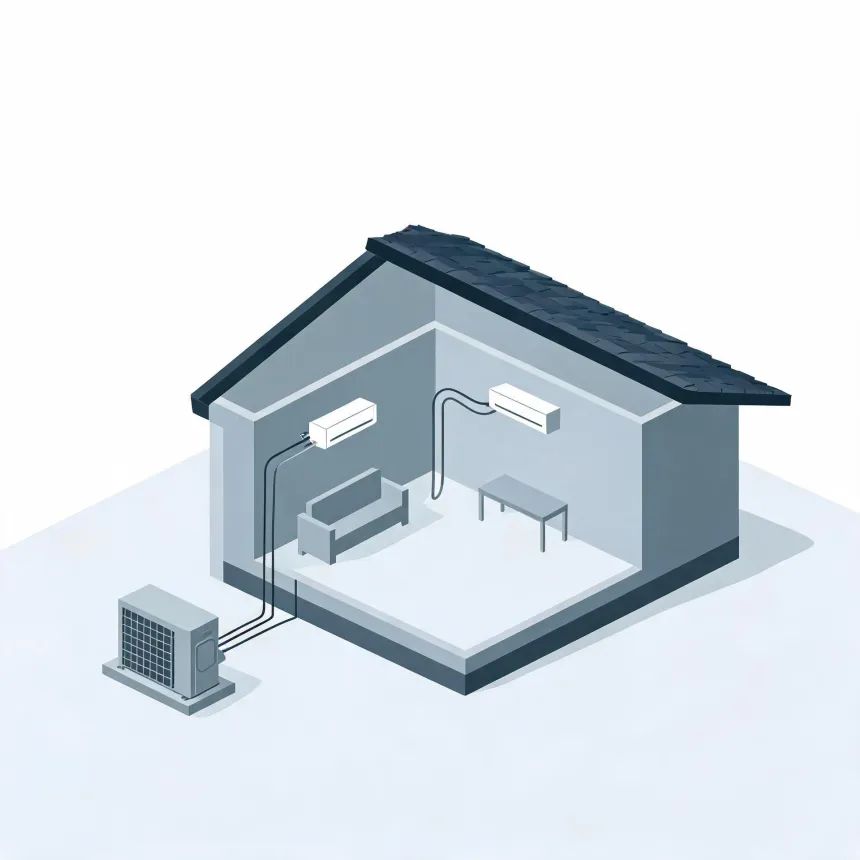
Install day starts outside and in, at the same time. One crew member mounts the outdoor unit on a pad or bracket while another runs the line set, the refrigerant lines that connect it to the indoor head. That line set has to pass through a wall, so there's a hole to drill, usually small, placed where it won't run through a stud or a pipe. Once the indoor unit is mounted and the lines are connected, the system gets evacuated with a vacuum pump to pull out air and moisture before the refrigerant ever flows. Skip that step and moisture sits in the lines, and that shows up later as a system that won't cool or heat right. After the vacuum holds, the refrigerant is released, the electrical connections are made, and the whole system gets tested running in both directions, cooling and heating, before anyone calls it done.