A row of similar gray-sided houses with gabled roofs and front porches behind a new wooden picket fence, with grass and mature trees along the street.

Mini Split Installation in Nantucket, MA

Tell us about the job

Takes about a minute. No obligation.

New system or replacementMini-splitNantucket County, MA
Step 1 of 2

What ZIP code is the job in?

Standard sizing works here

A mini split sized to the room it serves will heat and cool it fine on Nantucket. There's nothing about the island that calls for oversizing a system or stepping up to a higher efficiency tier than you'd use anywhere else in Massachusetts.

Efficiency still matters on the electric bill

Massachusetts homes paid 29.35 cents per kilowatt-hour in 2024, among the higher rates in the country. That makes the efficiency rating on a mini split worth checking, even though it doesn't change what size unit this job needs.

8 months
October through May, your system heats
2 months
July through August, it cools
28°F
the average winter night it heats against
74°F
the average summer afternoon it cools against
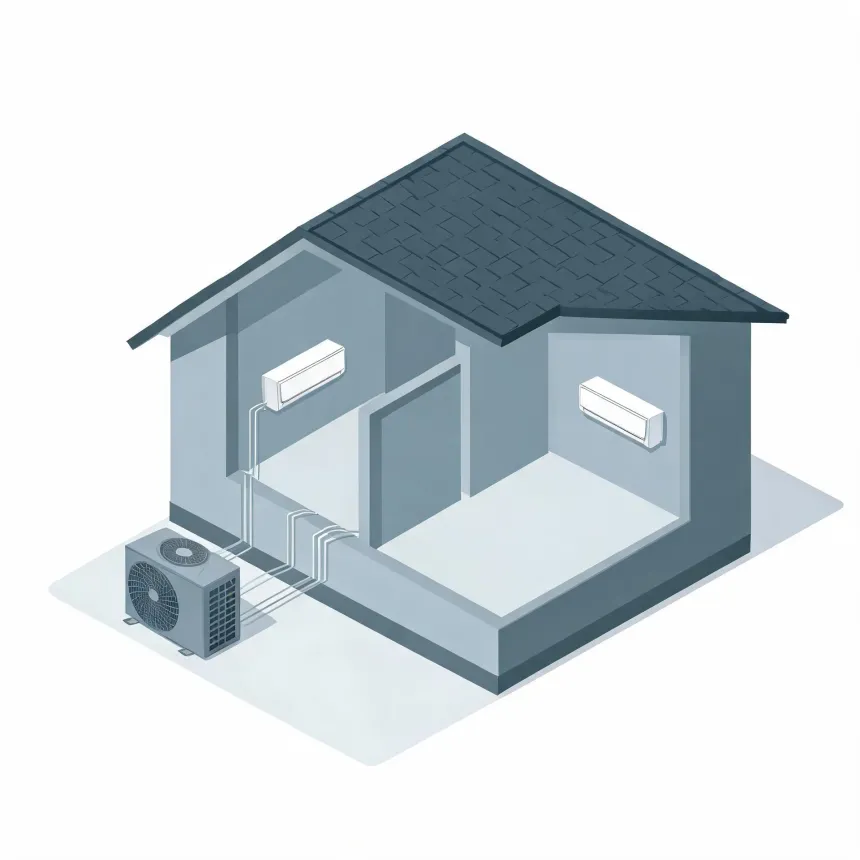
Isometric cutaway illustration of a small house showing two wall-mounted indoor air conditioning units connected by refrigerant lines to an outdoor condenser unit on the ground outside.
Your system heats October through May and cools July through August.

NOAA nClimDiv, 1991–2020 normals

Cooling runs about two months here, July and August, with afternoon highs averaging 74°F.

A mini split on Nantucket spends most of the year barely working, so a well-built standard model holds up fine.

Two months of cooling is a short window. Get it installed before July, not during it.

Cooling runs July through August
Summer afternoons average 74°F
60 damaging wind events from 2015 to 2024

Nantucket sits in climate zone 5A, a cool zone where heating carries more of the year than cooling. Any ductless heat pump installed here falls under the same federal rule as every split-system heat pump sold in the country. Built from 2023 on, it has to hit 14.3 SEER2 for cooling and 7.5 HSPF2 for heating. There's no separate ductless category and no island exception. That's a floor, not a ceiling, so a unit can always do better than the minimum. A federal tax credit is available for qualifying heat pump installations too, worth checking before you settle on a model.

A reliable mini split is the right call here, not the top-tier one

Two months of real work a year is not much strain on a mini split. Put the money into a well-built standard model instead of the top efficiency tier, and it should hold up fine here.

Find a contractor
A beige split-system air conditioner outdoor condenser unit mounted on metal wall brackets atop a stucco wall.

Getting the size right happens before the unit is bought

Sizing a mini split comes down to how much heat the room gains in summer and loses in winter, not the square footage alone. A contractor doing this right works through a load calculation that accounts for insulation, window area and orientation, ceiling height, and what's on the other side of each wall. Skip that step and guess from square footage instead, and the unit rarely matches the room. Oversized is the more common mistake, and it feels like a win at first because the room cools fast. But a unit that big satisfies the thermostat before it's pulled the moisture out of the air, so it cycles off and on all day and leaves the room cold and damp rather than just comfortable. Short cycling like that also puts more wear on the compressor than steady, longer runs would. Undersized is the other failure, and it shows up as a unit that runs flat out and still can't hold the temperature on the hottest or coldest days. Either mistake is built into the install from day one. There's no adjustment afterward that fixes a unit that was never sized to the room.

Ask about the zoning, not just the unit

One outdoor compressor can run multiple indoor heads, each one controlled on its own. That matters if some rooms need heat or cooling more than others. A single zone system only makes sense when you're treating one room on its own.

Ask where the line set and drain will run

The refrigerant lines and condensate drain have to get from the indoor head to the outdoor unit, through a wall and along an exterior path to the compressor. A longer or more complicated run can mean more wall penetrations and more line hidden in a cover, and it's worth seeing that plan before the work starts rather than after.

The quote for a mini split job moves on a few things that have nothing to do with the brand on the box. How many zones you're running is the big one. Each indoor head needs its own line set, its own mounting spot, and its own share of the outdoor unit's capacity, so adding zones adds labor at every step, not just at the end. Where the outdoor unit can go matters too. A compressor that sits right below the indoor head is a short, simple run. One that has to reach around a corner or up to a second floor means more line, more wall penetration, more time spent getting to the work itself. The condensate drain adds its own cost if gravity won't carry the water out and a pump has to do it instead. And the electrical feeding the outdoor unit is its own piece of work if the panel doesn't already have the capacity sitting there waiting.

The SEER2 and HSPF2 numbers on the label are tested maximums, not what the unit delivers every hour it runs. SEER2 covers cooling, HSPF2 covers heating, and both get measured under lab conditions that don't match a room on a mild afternoon or a bitter night. A higher number means the compressor can move more heat per unit of electricity it draws, but only when it's running near the conditions it was tested in. Most of the time a mini split runs at partial load, well under the extremes those numbers assume, which is where a well-built unit still performs fine without needing to chase the top of the range. The rating tells you about efficiency, not comfort and not capacity. A unit sized wrong for the room it serves will run poorly no matter what's printed on the label.