




White colonial houses with lit windows and dark shutters line a tree-lined street at dusk, bordered by dry-stacked stone walls.

Mini Split Installation in Lynn, MA

Tell us about the job

Takes about a minute. No obligation.

New system or replacementMini-splitEssex County, MA
Step 1 of 2

What ZIP code is the job in?

Electricity in Massachusetts ran 29.35 cents per kilowatthour in 2024, well above what most of the country pays. A mini split works against that by moving heat instead of making it, so it gets more out of every kilowatt than a baseboard heater or a window unit. That difference shows up most in a system that runs for months at a time, which is what heating and cooling both do here. The efficiency rating on the unit you choose matters more in a state like this than in one with cheap power, because every point of it is multiplied by that rate on every bill. Worth asking any contractor you talk to what SEER2 and HSPF2 numbers they're quoting, and why.

8 months
October through May, your system heats
2 months
July through August, it cools
21°F
the average winter night it heats against
79°F
the average summer afternoon it cools against
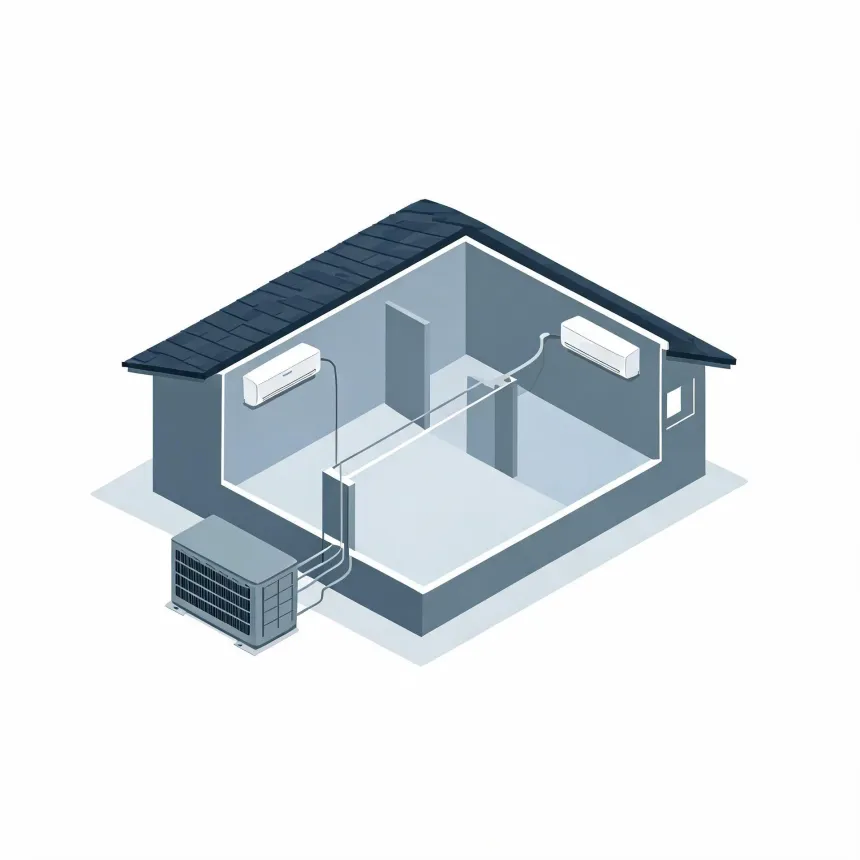
Isometric illustration of a cutaway house showing two wall-mounted mini-split indoor units connected by line sets to a single outdoor condenser beside the exterior wall.
Your system heats October through May and cools July through August.

NOAA nClimDiv, 1991–2020 normals

Cooling here runs about two months a year, July and August, with afternoon highs averaging 79°F.

A mini split in Lynn isn't working against heat load most of the year, so a reliable, well-matched unit holds up fine without reaching for the top efficiency tier.

Cooling here is short. Get the install done before July asks anything of it.

Cooling runs July through August
Summer afternoons average 79°F
256 damaging wind events from 2015 to 2024

Utility gas heats 56.4% of homes in Essex County, more than any other fuel. Fuel oil comes next at 20.4%, with electric heat behind that at 17.4%. A mini split doesn't replace a gas furnace. It takes over the months the furnace doesn't need to run full tilt, so the furnace only carries the coldest stretch of winter. In a home already heated with electricity, the mini split can do most of the work itself, since it moves heat instead of generating it the way a baseboard does.

The right size, installed right, is what this home needs

Essex County sees a real share of severe weather, 344 events over the past ten years, most of it wind and winter storms rather than hail or hurricanes. None of that calls for a bigger or pricier mini split than this home needs. A standard size, properly matched to the space, handles what the weather here asks of it. What's worth checking is the install itself, since a unit set up to run efficiently is the one that holds up through 54 winter storms and whatever comes after them.

Find a contractor
A white outdoor air conditioner condenser unit mounted on metal wall brackets against gray horizontal siding, with a blue sky and white clouds behind it.

This home has been here a while. The install should account for that.

Half the homes in Essex County were built in 1960 or earlier. A mini split doesn't care how old the house is, but the install does. Line sets have to run somewhere, usually through an exterior wall, and where that wall opens up and what's behind it changes with a house this age. Worth having the contractor walk the spot before anything gets mounted, not after.

Bigger isn't better

An oversized mini split cools the room fast, then shuts off before it pulls the moisture out of the air. That leaves the room cold and damp instead of just comfortable. The unit short cycles, turning on and off in quick bursts, and that wears on the compressor faster than a system that runs in long steady stretches.
The math behind the match

Sizing a mini split means working out a room's heat load. That means the square footage, how many windows it has and which way they face, how well it's insulated, what's on the other side of the walls. A contractor walks the space and runs those numbers rather than guessing from square footage alone. Get it wrong and the system either can't keep up on the hottest or coldest days, or cycles so often it never settles into an efficient run.

A mini split installation has more pieces than the unit on the wall. There's the indoor head, the outdoor compressor, the line set running between them carrying refrigerant, and the wiring to power it all. Every one of those adds labor. A single-zone setup with a short line run is the simplest version of this job. Add more zones, or route the line set through framing instead of a straight shot out an exterior wall, and the hours add up before the equipment cost even comes into it. The brand and tier of unit matter too, since a higher efficiency rating usually means a more complex compressor inside it. None of that is padding. It's what the install actually takes.

Installation day starts with the outdoor compressor, usually set on a pad or mounted bracket against the wall, close enough to the indoor head that the line set doesn't have to fight its way through the house to reach it. That line set, the refrigerant lines, the wiring, and the condensate drain, all get bundled and run through a single hole bored through the wall, then sealed against weather on the outside. Once the lines are run, the system gets evacuated with a vacuum pump to pull out moisture and air, because any left behind ruins the refrigerant's ability to do its job. Only after that is it charged with refrigerant and the lines checked for leaks under pressure. The indoor head goes up last, mounted to a plate fixed to the wall, leveled so condensate drains the way it should instead of pooling. A tech will run the system through a full cycle before calling it done, checking that it actually cools and heats, not just that it powers on.