
A two-story red brick house with a dark roof and white-trimmed windows sits on a lawn behind a stone retaining wall, framed by large leafy trees under an overcast sky.

Mini Split Installation in Greenfield, MA

Tell us about the job

Takes about a minute. No obligation.

New system or replacementMini-splitFranklin County, MA
Step 1 of 2

What ZIP code is the job in?

Most homes here run on oil

Fuel oil or kerosene heats 42.2% of occupied homes in Franklin County, more than any other fuel. Utility gas and electricity trail well behind. A lot of these homes have no ductwork at all, since oil heat usually runs through a boiler and radiators or baseboard.

That changes what a mini split is solving

Without ducts already in place, a mini split does not have to tie into anything. It runs its own line set to each room. That makes it a way to add cooling, or a second heat source, to a house that was built around a boiler and never had central air.

8 months
October through May, your system heats
2 months
July through August, it cools
17°F
the average winter night it heats against
80°F
the average summer afternoon it cools against
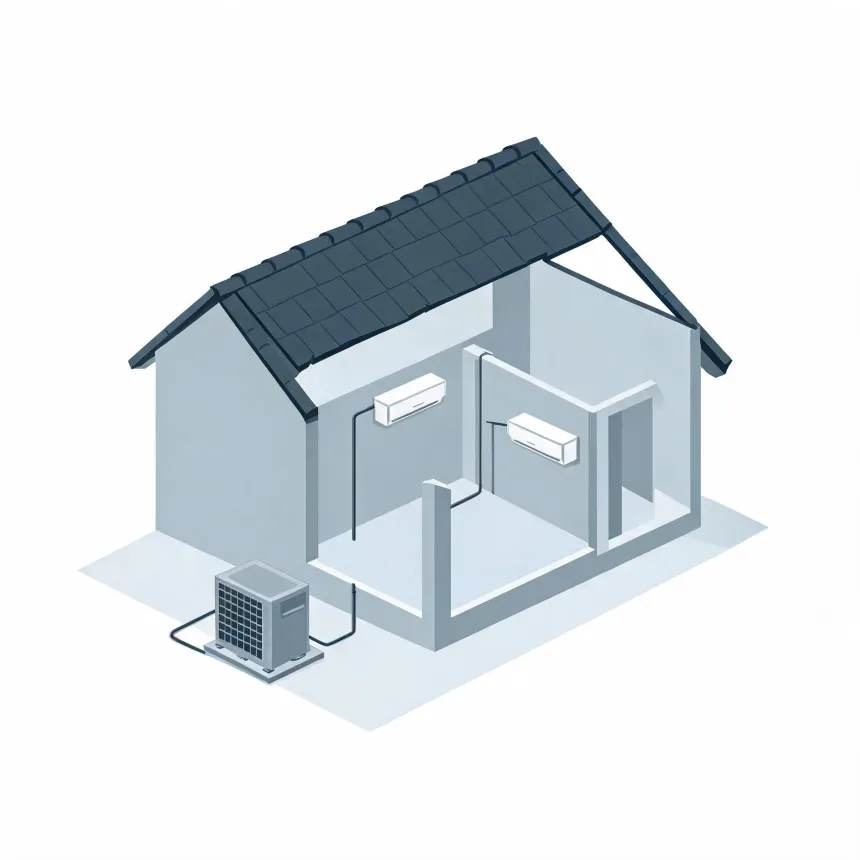
Isometric illustration of a cutaway house with a dark tiled gable roof, showing two wall-mounted indoor split air conditioning units connected by lines to an outdoor condenser unit on the ground outside.
Your system heats October through May and cools July through August.

NOAA nClimDiv, 1991–2020 normals

Electricity in Massachusetts ran 29.35 cents per kilowatt-hour in 2024.

A mini split sized right for the room costs less to run than one sized too big for it.

Half these homes were built by 1962. A mini split has to fit the house you have, not a standard one.

Half the homes here were built by 1962
Cooling runs July through August
Summer afternoons average 80°F

A standard mini split, sized and installed the normal way, holds up fine here. Greenfield sees its share of rough weather, including plenty of damaging wind and a few winter storms every year with heavy snow or ice. None of that calls for a different unit or a bigger one. The outdoor condenser is built to sit outside through wind, snow and ice as a matter of course. What matters more is what happens when the power goes out. About 1 in 10 Massachusetts households went at least a full day without power in 2024, and a mini split, like any electric heat or cooling system, stops working until power is back.

Two light months of cooling, so fit matters more than top efficiency

Cooling here runs about two months a year, July and August, with afternoon highs around 80°F. That is a light job for a mini split. Heating carries the bigger load across the rest of the year. A system that is not working hard most of the time does not need top-tier efficiency to be worth installing, just a size that matches the room and a installation done right.

Find a contractor

The boiler usually stays

A mini split doesn't replace the boiler or the radiators. It adds cooling and a second way to heat a room, so the old heating system typically keeps running the way it always has, especially as backup for the coldest stretches.

Removing baseboard or radiators is a separate job

If a room gets a mini split and the owner wants the old radiator or baseboard unit out of the way, that's plumbing and heating work on top of the mini split installation itself, not part of it. Left in place, they still work fine as backup heat.

Comparing mini splits mostly means comparing the parts you can't see once it's installed. Ask how they're arriving at the size for each room, and whether that's a real room by room load calculation or a guess based on square footage. A unit sized by eye runs short cycles, never settles into steady low speed, and wears out faster for it. Ask what happens at the wall, too. The line set, the drain, and the electrical whip all have to get from the indoor head to the outdoor condenser somehow, and a sloppy job means a visible chase or a wall full of patched holes. Ask who services it after the install, since a mini split needs the filters cleaned and the outdoor coil kept clear to keep running the way it did on day one. And ask what the warranty actually covers, because most manufacturers only honor the full warranty when the installer is certified on that brand.

Installation day starts outside, picking the spot for the condenser. It needs clearance on all sides for airflow, and it needs to sit level, usually up on a pad or brackets rather than straight on the ground. Indoors, the installer mounts a bracket on the wall, runs the line set through a hole drilled straight through to the outside, then hangs the indoor head on the bracket and connects the lines. Once everything is joined, the system gets evacuated with a vacuum pump to pull out air and moisture before the refrigerant is released into the lines. That step matters more than people expect. Any moisture left behind can damage the compressor down the road, so a rushed vacuum is the kind of shortcut that doesn't show up until the unit's been running for a while.