



A white picket fence runs along a mowed grass lawn in front of a row of gray clapboard houses with dark shingled roofs, framed by overhanging tree branches under an overcast sky.

Mini Split Installation in Cambridge, MA

Tell us about the job

Takes about a minute. No obligation.

New system or replacementMini-splitMiddlesex County, MA
Step 1 of 2

What ZIP code is the job in?

Massachusetts electricity ran 29.35 cents per kilowatt-hour in 2024, well above what most states pay. A mini split that's running efficiently matters more here than somewhere with cheap power, because every inefficiency shows up bigger on the bill. The inverter-driven compressor in a mini split adjusts its speed to match the load instead of switching fully on and off, which is where a lot of the savings against older systems comes from. That matters on a cold night when the system is running for hours at a stretch, not just cycling on for a few minutes. Installation quality affects this too. A unit sized wrong for the room, or lines run poorly, will cost you more to run no matter how efficient the equipment is rated.

8 months
October through May, your system heats
2 months
July through August, it cools
19°F
the average winter night it heats against
81°F
the average summer afternoon it cools against
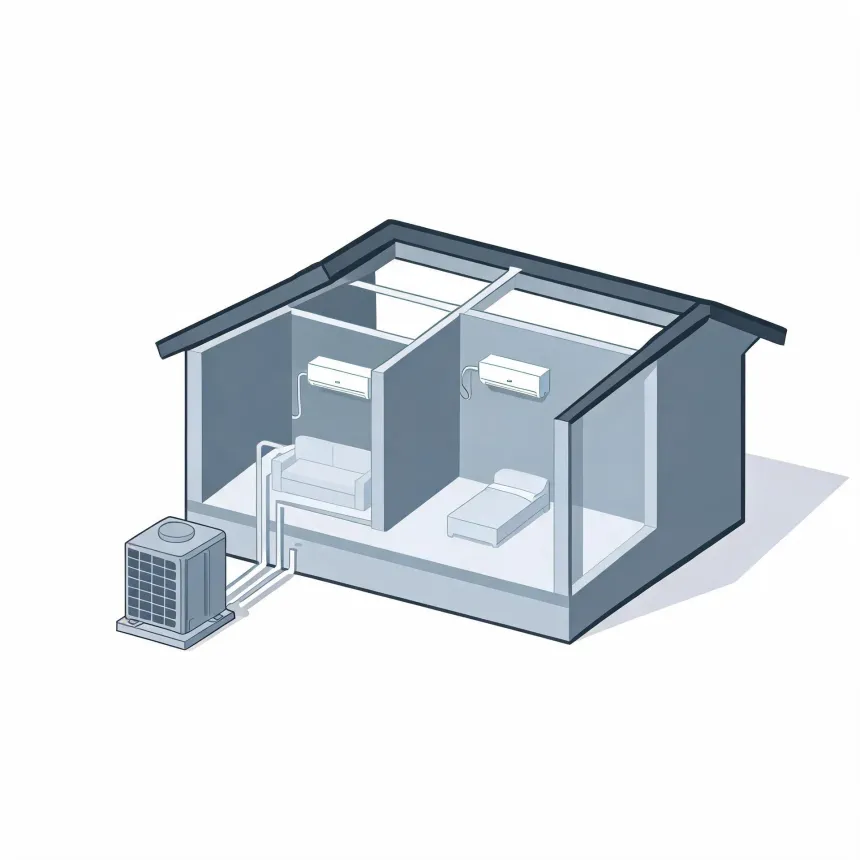
Illustrated cutaway of a two-room house showing two wall-mounted indoor air conditioning units connected by pipes to an outdoor condenser unit on the ground outside.
Your system heats October through May and cools July through August.

NOAA nClimDiv, 1991–2020 normals

Cooling in Cambridge only runs July through August.

Get a mini split installed before June and it's ready on its own schedule, not a rushed one.

Gas heats most homes here, so a mini split usually adds cooling rather than replacing the furnace

59.3% of homes heat with gas
Cooling runs July through August
Summer afternoons average 81°F

Cambridge winters are the bigger load here, and summer only asks for two months of cooling with afternoons averaging around 81°F. That's not a tough number for a mini split to hit. A standard size, set up for the room it's cooling, handles it without needing anything oversized or special for this area. Where sizing does matter is making sure the unit matches the space it's actually serving, since a system too big for the room cycles on and off more than it should and one too small just runs flat out without catching up.

A mini split here has to meet zone 5A's standard, and a federal credit can offset it

Any mini split installed here has to clear 14.3 SEER2 for cooling and 7.5 HSPF2 for heating, the federal minimum for split-system heat pumps. That floor is what keeps a unit from costing more than it should on a Massachusetts bill. A federal tax credit is available on top of that for qualifying equipment, worth asking a contractor about when you're comparing units.

Find a contractor
A white mini-split air conditioner outdoor condenser unit mounted on metal brackets against a beige stucco exterior wall, with a blue sky and scattered clouds in the background.

An older house changes how the lines get run

Half the homes in Middlesex County were built in 1962 or earlier. A house that old was built before mini splits existed, so whatever's heating and cooling it now was fitted in later, sometimes more than once. That matters for this install because the line set and the indoor unit have to route through walls and framing that were never planned around them. A contractor who's done this in older houses around here will know to check how the walls are built before running lines, not after.

How many zones, and where the lines run

A mini split system can run one indoor head or several off a single outdoor compressor. Ask how many zones the quote is based on and whether that outdoor unit has room to add another head later if you want to cool or heat more rooms down the line. Also ask where the line set runs between indoor and outdoor units. A long run, or one with a lot of bends, asks more of the compressor than a short straight shot.
What happens below freezing

If this system is meant to carry any of the heating load, ask how it performs at low outdoor temperatures, not just what it's rated for at mild conditions. Some heat pumps lose capacity fast as it gets colder outside and need backup heat to keep up. Get the contractor to say plainly whether this unit is built to handle cold snaps on its own or whether it's leaning on another heat source when it matters most.

The SEER2 and HSPF2 numbers on the label are ratios, not a measure of how much the unit heats or cools. SEER2 compares the cooling put out over a season to the electricity it takes to do it, and HSPF2 does the same for heating. A higher number means less electricity for the same result, nothing about the size of room it can handle. Units with the same rating can still behave differently in your house, because the rating is tested under set lab conditions, not the conditions in your walls. What actually determines the bill is that rated efficiency combined with a unit sized right for the space and installed with a clean line set. A high rating on a unit that's the wrong size for the room won't save you what the label suggests.

Installation starts with the outdoor compressor and where it sits. It needs clearance on all sides for airflow and a spot that drains properly, since it pulls moisture out of the air even in heating mode. Indoors, the installer mounts the head on an exterior wall where it can run a short, mostly straight line set to the compressor, usually through a single hole drilled for the refrigerant lines, power, and drain. Once the lines connect, the system gets evacuated with a vacuum pump to pull out air and moisture before the refrigerant charge goes in. That vacuum step matters more than people think, because any air or moisture left in the lines makes the compressor work harder for the life of the unit. After that, it's a pressure test, a check of the charge, and running the system in both modes before the installer walks you through the thermostat or remote.