






A single-story light gray house with dark shingled roof and black shutters sits on a mown lawn, framed by overhanging tree branches and blurred grass and shrubs in the foreground.

Mini Split Installation in Boston, MA

Tell us about the job

Takes about a minute. No obligation.

New system or replacementMini-splitSuffolk County, MA
Step 1 of 2

What ZIP code is the job in?

Electricity in Massachusetts ran 29.35 cents per kilowatthour in 2024, well above what most of the country pays. A mini split earns its keep on that kind of bill. These systems move heat instead of burning fuel to make it, so they get more warmth or cooling out of every kilowatt than older electric heat does. In a state where every kilowatt costs more, that efficiency is worth more too. The gap between a system that runs well and one that doesn't shows up every month, not just on the install invoice.

8 months
October through May, your system heats
2 months
July through August, it cools
23°F
the average winter night it heats against
80°F
the average summer afternoon it cools against
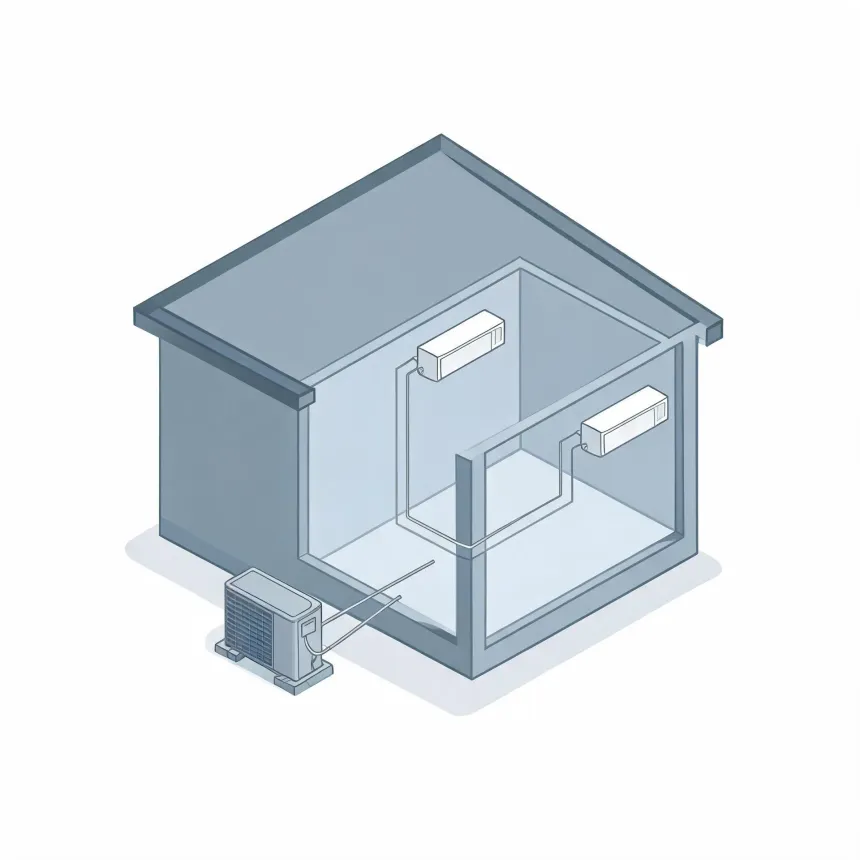
Isometric line illustration of a cutaway building interior with two wall-mounted indoor air conditioning units connected by piping to an outdoor condenser unit on the ground outside.
Your system heats October through May and cools July through August.

NOAA nClimDiv, 1991–2020 normals

Cooling in Suffolk County runs July through August.

June is the month to get a mini split installed, before the first hot day puts it to work.

Two months of cooling a year doesn't call for the biggest unit on the lot

Cooling runs July through August
Summer afternoons average 80°F
140 damaging wind events from 2015 to 2024
Most homes here run on gas. A mini split adds electric cooling and heat without touching it.Gas heats 56.9% of homes in Suffolk County, electricity heats 30.8%.

Suffolk County sits in climate zone 5A, a cool zone where heating carries more of the year's load than cooling does. Any mini split installed here falls under the same federal rule as other split-system heat pumps. Units built from 2023 on have to hit 14.3 SEER2 for cooling and 7.5 HSPF2 for heating. There's no separate, lower bar for going ductless. A contractor quoting a system below those numbers isn't quoting something legal to install here. Above that minimum, there's room to choose, and a federal tax credit applies to the higher-efficiency units that qualify.

Half these homes were built in 1949 or earlier. Your mini split needs to fit that house.

Half the homes in Suffolk County were built in 1949 or earlier. A mini split going into a house that old has to be sized and placed for the walls and rooms you actually have, not a standard floor plan. That matters more here than in a county full of new construction.

Find a contractor
A man in a dark T-shirt and tan work pants, seen from behind, climbs porch steps toward a blue front door while carrying a canvas tool bag filled with hand tools.
A beige split-system air conditioner outdoor condenser unit mounted on metal wall brackets atop a stucco wall.

Size it to the house, not the average

A load calculation before the quote tells you where the heads go and how many you need. Skip it and you get a unit sized for a floor plan that isn't yours, running short in some rooms and cycling too much in others. That calculation matters more once you're into a house old enough to have additions, converted attics, or rooms that were never meant to share one system.

If you're replacing a system that heated with gas, the old equipment usually stays

Adding a mini split doesn't mean tearing out a furnace or boiler. Most of the time the existing gas system stays in place as backup or primary heat, and the mini split works alongside it. A contractor can disconnect and haul away old window units or an old through-wall AC as part of the install.

An old ducted system gets capped off, not ripped out

If there's an existing central air system that's failing, a contractor can leave the ductwork alone and just stop using it, or remove the outdoor condenser and indoor coil while leaving ducts for the furnace to keep using. Nothing about installing a mini split requires tearing out ductwork that still serves the furnace.

SEER2 and HSPF2 are both ratios, not amounts. SEER2 measures cooling output against the electricity it takes to produce it over a season, and HSPF2 does the same for heating. A higher number means the system pulls more heat or more cooling out of the same bit of electricity, nothing more. It doesn't tell you how big a space the unit can handle or how fast it brings a room to temperature. Mini splits carrying the same rating can still behave differently from house to house, because placement and sizing decide how that efficiency actually shows up once it's running. The rating only pays off once the unit has been matched to the load correctly.

Install day starts with the outdoor unit and the line set, the copper tubing that carries refrigerant between outside and in. A tech runs that line set through a small hole drilled in the wall behind where each indoor head will hang, then mounts the head on a bracket and connects the lines, the drain hose, and the electrical whip. The outdoor unit gets set on a pad or wall bracket with enough clearance to pull air through the coil. Once everything's connected, the system gets evacuated with a vacuum pump to pull out moisture and air before refrigerant ever goes in. Skip that step and moisture sits in the lines, and that leads to compressor trouble down the road. The last part is running the system through both heating and cooling, checking the line pressures, and confirming each head is actually blowing at the temperature it should.